
What Is Embryo Transfer in IVF?
Embryo transfer is one of the final and most important stages of an IVF cycle. During the procedure, an embryo that has developed in the IVF laboratory is carefully placed inside the uterus using a thin catheter.
The goal is for the embryo to subsequently implant in the uterine lining and establish a pregnancy.
The transfer itself is usually much simpler than egg retrieval and commonly does not require sedation. nhs.uk
If you are new to fertility treatment, start with our [What Is IVF? Complete Beginner’s Guide] to understand the complete IVF process.
What Happens Before Embryo Transfer?
Several important steps take place before the actual embryo transfer.
1. Embryo Development in the IVF Laboratory
After egg retrieval, the collected eggs are fertilized using conventional IVF or ICSI.
The resulting embryos are cultured and monitored in the embryology laboratory.
Depending on the treatment plan, embryo transfer may take place at different developmental stages. For example, some clinics transfer embryos on Day 2 or Day 3, while blastocyst transfer typically occurs around Day 5. Guys and St Thomas’ Hospital
Internal link: Read our [Egg Retrieval Procedure Explained] to understand how the eggs used for IVF are collected.
2. Embryo Assessment
Before transfer, the embryology team assesses the available embryos.
Depending on the developmental stage, characteristics such as cell division, fragmentation, blastocyst expansion, inner cell mass and trophectoderm appearance may be considered.
Embryo grading provides useful information, but it should not be interpreted as a guarantee that a particular embryo will or will not implant.
Internal link: This is an excellent place to link your upcoming article [Embryo Grading Explained: What Do Embryo Grades Mean?].
3. Preparing the Endometrium
The endometrium is the lining of the uterus where implantation occurs.
In a fresh IVF cycle, embryo transfer follows ovarian stimulation and egg retrieval.
In a frozen embryo transfer (FET) cycle, the endometrium may be prepared through a natural or medication-supported protocol depending on the patient’s circumstances.
Your fertility specialist determines the appropriate timing based on the treatment protocol.
4. Deciding How Many Embryos to Transfer
The number of embryos transferred is an important clinical decision.
It depends on several factors, including patient characteristics, embryo-related factors, previous treatment history and professional recommendations.
Transferring more embryos can also increase the possibility of multiple pregnancy, which is why the decision should be individualized rather than simply transferring as many embryos as possible. ESHRE provides evidence-based recommendations specifically addressing the number of embryos transferred during IVF/ICSI. ESHRE
What Happens on the Day of Embryo Transfer?
For many patients, embryo transfer day is one of the most anticipated moments of the IVF journey.
The procedure itself is generally straightforward.
Step 1: Patient and Embryo Verification
Before transfer, the fertility team confirms the patient’s identity and the embryo(s) intended for transfer.
The doctor and embryologist may also discuss the number and developmental stage or quality of the embryo(s).
Step 2: Preparing for the Procedure
Some clinics ask patients to arrive with a comfortably full bladder.
A full bladder can help provide a clearer abdominal ultrasound view and may assist catheter placement during ultrasound-guided embryo transfer. Guys and St Thomas’ Hospital
Always follow the instructions given by your own fertility clinic.
Step 3: The Embryo Is Loaded Into the Transfer Catheter
Inside the IVF laboratory, the embryologist prepares the selected embryo for transfer.
The embryo is carefully loaded into a thin embryo-transfer catheter in a small volume of culture medium.
This is a highly controlled laboratory step requiring correct patient identification and careful embryo handling.
Step 4: The Catheter Is Passed Into the Uterus
A speculum is placed so the cervix can be visualized.
The clinician then carefully guides the transfer catheter through the cervix and into the uterine cavity.
Ultrasound guidance is commonly used to help position the catheter appropriately. Evidence reviewed in embryo-transfer guidance supports transabdominal ultrasound guidance during the procedure. ESHRE
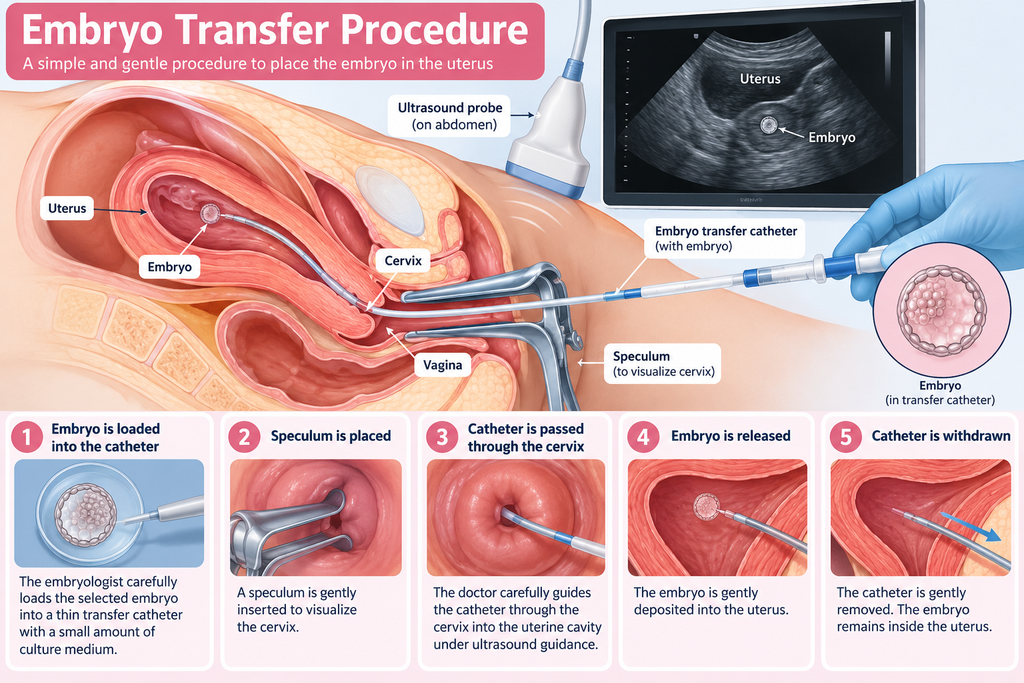
Embryo transfer procedure in IVF using a catheter
Step 5: The Embryo Is Released
Once the catheter is positioned appropriately, the embryo is gently deposited into the uterine cavity.
The catheter is then withdrawn.
At some centres, the embryologist checks the catheter afterward to confirm that the embryo is no longer inside it. Cambridge IVF
This entire procedure is generally much simpler than egg retrieval and usually does not require sedation. Guys and St Thomas’ Hospital
Does Embryo Transfer Hurt?
Most patients experience little or mild discomfort rather than significant pain.
Some discomfort may come from the speculum or from having a full bladder during ultrasound-guided transfer.
Experiences vary from person to person.
What Happens Immediately After Embryo Transfer?
A very common fear is:
“Can the embryo fall out if I stand up or walk?”
Normal movement does not cause the transferred embryo to simply fall out of the uterus.
More importantly, prolonged bed rest has not been shown to improve IVF outcomes after embryo transfer. Evidence-based embryo-transfer guidance specifically does not recommend bed rest after transfer. ESHRE
Patients can generally return to normal light daily activities according to their clinic’s instructions.
What Should You Do After Embryo Transfer?
Continue Your Prescribed Medicines
Continue progesterone or any other medication exactly as prescribed by your fertility specialist.
Do not stop medication because of spotting, cramps or because you think your period may be starting unless your clinic tells you to do so.
Medication schedules vary considerably between fresh, frozen and donor cycles, so follow your own clinic’s protocol.
Normal Daily Activity Is Usually Fine
You generally do not need to remain in bed after embryo transfer.
Walking and ordinary daily activities are usually acceptable.
There is good evidence that bed rest does not improve pregnancy outcomes after embryo transfer. Reproductive Facts
Follow your fertility team’s advice regarding strenuous exercise or any restrictions specific to your treatment.
Eat a Normal Balanced Diet
There is no scientifically proven “implantation food” that guarantees embryo implantation.
Focus instead on a balanced diet containing vegetables, fruits, whole grains, adequate protein and appropriate fluids.
Avoid starting supplements, herbal products or medications without discussing them with your doctor.
Internal link: Read [How to Prepare Your Body for IVF] for more practical nutrition and lifestyle guidance.
Symptoms After Embryo Transfer
The waiting period after transfer can be emotionally difficult because patients often analyze every physical sensation.
Some people may experience:
- Mild abdominal cramping
- Bloating
- Breast tenderness
- Fatigue
- Vaginal discharge
- Light spotting
But symptoms alone cannot reliably tell you whether implantation has occurred.
Progesterone and other fertility medications can produce symptoms similar to early pregnancy.
Similarly, having no symptoms at all does not mean the transfer has failed.
When Does Implantation Happen?
Implantation is a biological process in which the embryo establishes contact with and embeds into the receptive endometrium.
Its timing depends partly on the developmental stage of the embryo at transfer.
This process cannot normally be felt or confirmed by symptoms alone.
Ultimately, pregnancy testing followed by appropriate clinical follow-up is needed to determine the outcome.
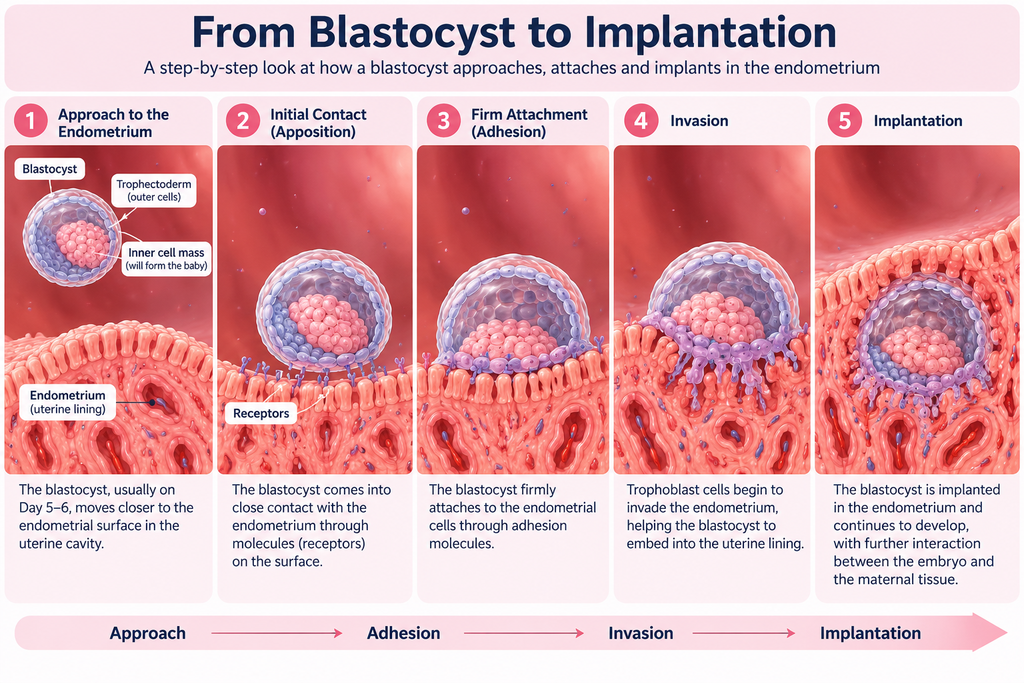
Blastocyst implantation after IVF embryo transfer
When Should You Take a Pregnancy Test After Embryo Transfer?
Your IVF clinic should provide a specific pregnancy-test date.
Do not rush to test too early.
Testing prematurely can produce misleading results, particularly because the hCG trigger injection used earlier in some IVF cycles can remain detectable for several days. Guys and St Thomas’ Hospital
Different clinics use somewhat different testing schedules, so the date given by your own clinic should take priority.
If the pregnancy test is positive, an early ultrasound is generally arranged later to confirm the location and development of the pregnancy. nhs.uk
When Should You Contact Your IVF Clinic?
Contact your fertility team if you experience concerning symptoms such as heavy bleeding, significant or worsening abdominal pain, fever/feeling unwell, faintness, or other symptoms your clinic has advised you to report. Guys and St Thomas’ Hospital
Severe or unusual symptoms should not simply be assumed to be part of implantation.
Common Myths After Embryo Transfer
Myth: You must stay in bed after embryo transfer.
Fact: Prolonged bed rest is not recommended as a way to improve IVF success. Reproductive Facts
Myth: Walking can make the embryo fall out.
Fact: Normal movement after transfer does not cause an embryo to simply fall out of the uterus.
Myth: No symptoms mean the transfer has failed.
Fact: Symptoms are not a reliable way to determine whether implantation has occurred.
Myth: Special foods guarantee implantation.
Fact: No particular food can guarantee successful implantation.
Internal link: Read [Common IVF Myths vs Facts] for more evidence-based IVF information.
Fresh vs Frozen Embryo Transfer
An embryo transfer may be performed as a fresh embryo transfer or frozen embryo transfer (FET).
In a fresh transfer, an embryo is transferred during the same treatment cycle in which the eggs were retrieved.
In FET, a previously cryopreserved embryo is warmed and transferred in a later cycle.
The best approach depends on the patient’s clinical situation and treatment plan.
Frequently Asked Questions About Embryo Transfer
How long does embryo transfer take?
The actual transfer is usually a relatively short procedure, although total appointment time varies between fertility centres.
Is anesthesia required?
Embryo transfer is generally simpler than egg retrieval and commonly does not require sedation. Guys and St Thomas’ Hospital
Can I walk after embryo transfer?
Yes. Routine bed rest has not been shown to improve outcomes. ESHRE
Can I go to the toilet after embryo transfer?
Yes. Using the toilet will not cause the embryo to fall out of the uterus.
Should I take complete bed rest?
No evidence supports routine prolonged bed rest after embryo transfer. Follow any individualized instructions from your treating doctor. Reproductive Facts
Can I travel after embryo transfer?
Many patients can resume normal activities, but travel plans should be discussed with the treating clinic, especially if there are medical concerns or a need for follow-up.
When can I know whether embryo transfer was successful?
Take the pregnancy test on the date recommended by your fertility clinic rather than relying on symptoms or testing very early.
Final Thoughts
Embryo transfer may last only a short time, but it represents the culmination of several carefully coordinated stages of IVF—from ovarian stimulation and egg retrieval to fertilization, embryo culture and selection.
After transfer, the most important steps are simple: follow your prescribed medications, maintain normal sensible activity, follow your clinic’s instructions and wait until the recommended date for pregnancy testing.
For a complete understanding of the journey, continue reading:
What Is IVF? → IVF Step-by-Step → Egg Retrieval Procedure → Embryo Transfer → Embryo Development & Implantation
Medical Disclaimer
This article is intended for educational purposes and does not replace individualized medical advice. IVF protocols and post-transfer instructions can differ between patients and clinics. Always follow the advice of your fertility specialist.
Internal-link structure for your website
For this article, I recommend linking 5 existing Cell to Soul posts: What Is IVF?, IVF Step-by-Step, Egg Retrieval Procedure Explained, How to Prepare Your Body for IVF, and Common IVF Myths vs Facts. Then, when you publish Embryo Grading, Day 1–5 Embryo Development, and Frozen Embryo Transfer, link those articles back to this page. This will start building a strong IVF topic cluster around your embryo-transfer content.